Web & full-stack
Business websites, full-stack platforms and the workflows behind them.
Web Platforms
Mob Moves
An animation production platform with automatic FBX conversion, validation, library registration and Minecraft previews.
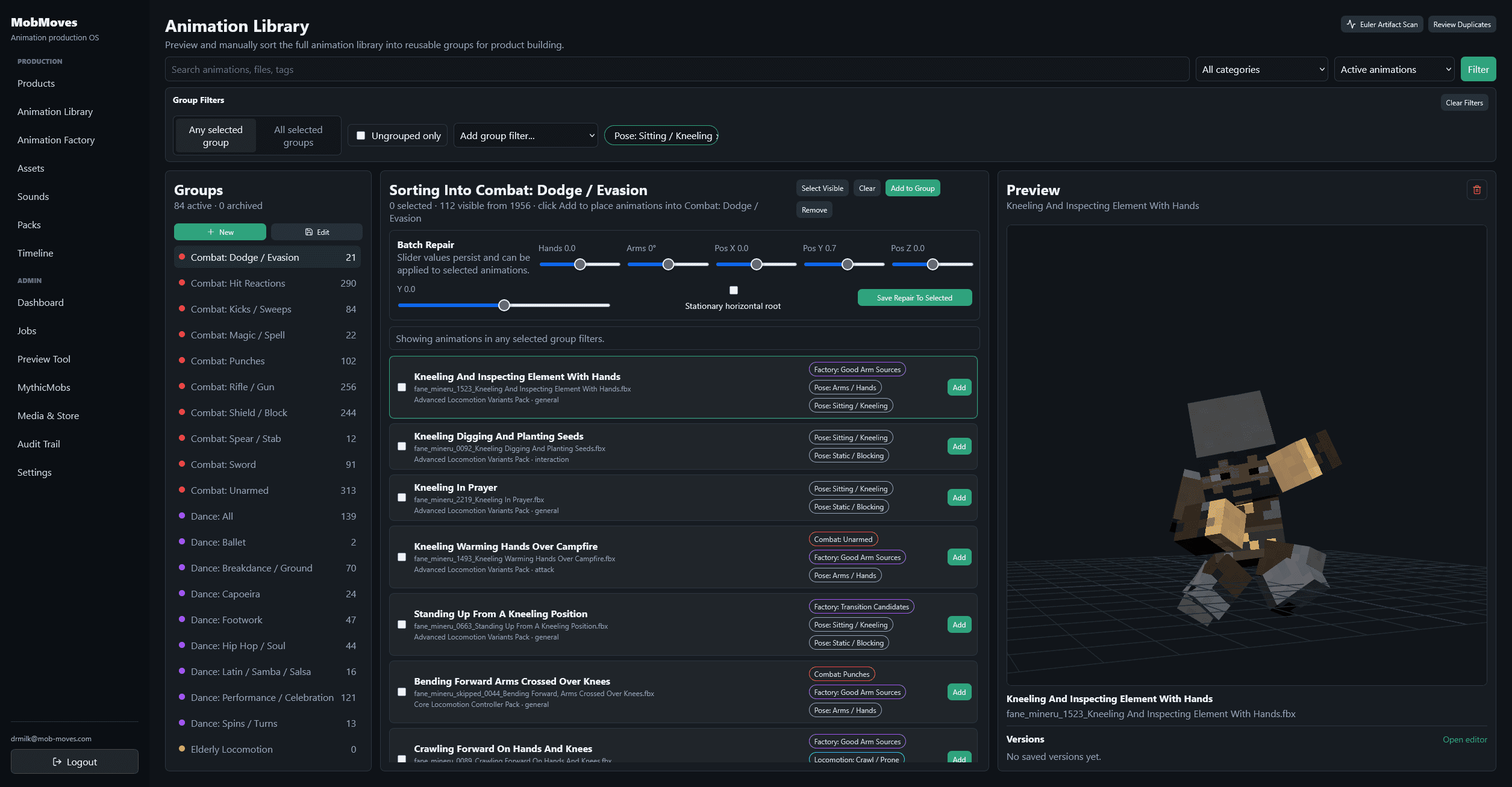
I built Mob-Moves to process and manage Minecraft animation work in one platform. Uploaded FBX files enter a worker queue, convert into validated animation and model outputs, and register in the library with duplicate detection and collection assignment. Integrated tools handle corrections, revisions, composition, product exports and release packaging. Production Scenes adds spatial authoring, entities, quest flows and cinematics. The complete quest-to-server publication workflow is still under development.
Private production OS for turning Minecraft animation libraries into sellable product packs.
- Automatic conversion, validation and library registration
- Batch corrections and immutable animation revisions
- Minecraft world, actor and animation previews
- Product exports and release packaging
- Scene and TypeWriter authoring tools under development
Next.js · TypeScript · Prisma · PostgreSQL · Three.js · Blockbench
Case study features and evidence
The platform connects authenticated admin surfaces, PostgreSQL data modelling, file-backed production assets, Three.js preview tooling, Blockbench export logic, MythicMobs handoff workflows, QA tracking, and release planning.
Next.js · TypeScript · Prisma · PostgreSQL · Three.js · Blockbench · Systemd · VPS
Release dashboard
Readiness views for products, blockers, missing media, stale export jobs, QA issues, and release candidates.
Product workspaces
Product detail pages that connect animations, models, generated artifacts, media, store copy, MythicMobs config, and status.
Animation library
Browse, search, group, exclude, and review large animation catalogs before they become commercial packs.
Repair studio
Revision-aware animation correction with preview-safe transforms, offset controls, root motion handling, and Blockbench-safe export separation.
Animation factory
Tools for recombining body segments from different animations to create new product variations faster.
Store preparation
Media, copy, product metadata, and release packaging workflows designed around actually selling the packs.
Export pipeline
Native Blockbench `.bbmodel` generation, validation, artifact history, stale checks, and job tracking.
Operations
Authenticated access, API tokens, audit trail, import scripts, deployment notes, and server-side workflow controls.
Evidence
- Specialized internal software for a real production workflow.
- Combines web UI, 3D preview, file processing, data modelling, and release operations.
- Built around a real production bottleneck: converting creative assets into sellable products reliably.
Visit Mob Moves ↗Web Platforms
Games of Education
A polished nonprofit landing website for a gamified education association, with strong visual identity, conversion modals, contact paths, and legal footer content.
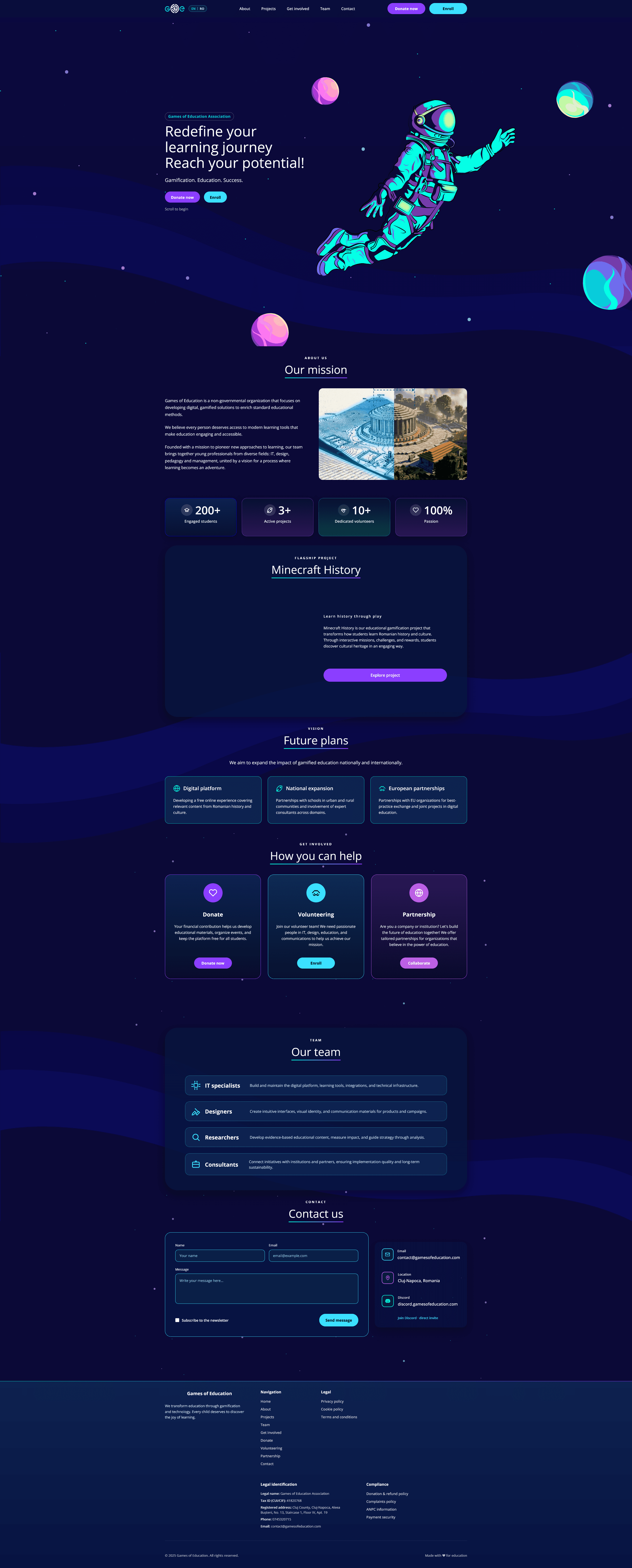
Games of Education is a production nonprofit website for an association focused on gamified learning. The site presents the mission, flagship Minecraft History project, future plans, involvement paths, team structure, contact details, Discord access, legal pages, and organization identification details through a responsive space-themed interface.
Next.js nonprofit website with bilingual navigation, gamified education storytelling, donation and volunteer enrollment flows.
- Responsive landing page with space-themed hero artwork, sticky navigation, and bilingual RO/EN language paths
- Mission, impact statistics, flagship project, future plans, involvement options, team roles, and contact sections
- Secure donation modal with preset/custom amounts, recurring toggle, donation summary, and payment-step handoff
- Volunteer enrollment modal with profile summary, contact details, phone/city fields, and multi-step form structure
Next.js · Responsive Web · Bilingual UX · Donation Flow · Volunteer Forms · SEO Structure
Case study features and evidence
The site turns a nonprofit mission into a polished public experience: mission, impact numbers, flagship Minecraft History project, future plans, involvement paths, team roles, contact details, Discord access, and legal information.
Next.js · Responsive web · Bilingual UX · Conversion modals · Contact forms · Legal content
Bilingual navigation
RO/EN language paths, sticky desktop navigation, mobile menu behavior, and section anchors for about, projects, involvement, team, and contact.
Narrative landing page
A complete public story around the association mission, impact stats, Minecraft History project, future plans, ways to help, team roles, and contact.
Donation flow
Secure donation modal with preset amounts, custom amount entry, recurring donation toggle, fee/total summary, compliance messaging, and payment handoff.
Volunteer enrollment
Volunteer modal with profile summary, contact details, phone/WhatsApp and city fields, and a step-based recruitment flow.
Contact and newsletter
Contact form with newsletter opt-in, email, location, Discord links, and direct communication paths for supporters and partners.
Legal and trust footer
Footer structure with navigation, privacy/cookie/terms links, legal identification, donation/refund policy, complaints policy, ANPC, and payment safety links.
Evidence
- Live nonprofit website with a distinctive visual system and responsive layout.
- Shows more than static brochure content: donation and volunteer conversion flows are part of the experience.
- Good proof of client-site polish, content architecture, trust-building, and business/nonprofit CTA design.
Visit Games of Education ↗Web Platforms
Edenth
Modern dental clinic website focused on professional presentation, service discovery, and clear contact paths.
Edenth is presented as client-facing dental clinic web work: a polished business website with treatment/service pages, clinic story, team presentation, prices, contact information, and a modern trust-building structure for a local medical audience.
Polished clinic website with treatment pages, team content, pricing, story, contact, and local-business trust signals.
- Treatment pages for dental-service discovery
- Team, story, pricing, and contact pages
- Professional medical tone and local-business positioning
- Clear phone and contact path for appointment intent
Responsive Web · SEO Structure · Service Pages · Contact UX · Business Content
Case study features and evidence
The site presents medical services with a professional tone, structured content, and clear paths toward contact and appointment intent.
Responsive web · SEO pages · Service content · Contact flows · Business presentation
Treatment pages
Dedicated dental service pages that explain care areas instead of forcing everything into one generic services block.
Team presentation
Clinic credibility through medical team content and a more human, trust-building website structure.
Pricing page
Separate prices/tarife area for visitors who need practical decision-making information before booking.
Contact path
Clear clinic contact details, phone-first access, and location information for local search intent.
Story page
Narrative clinic positioning around a more empathetic, modern dental experience.
Public live site
A client-facing production website that can be reviewed directly by potential customers.
Evidence
- Business-site polish and clear content architecture.
- Built for a real clinic audience, not only technical users.
- Focused on presentation, trust, and conversion.
Visit Edenth ↗Web Platforms
Dentistry by M
Practical dental clinic website built around booking intent, service clarity, and direct local contact.
Dentistry by M is a local clinic website with hero positioning, appointment CTA, dental service categories, about content, contact form fields, phone/email/address visibility, schedule information, and a compact structure suitable for a medical business.
Appointment-focused clinic site with service sections, contact form, phone/email/address visibility, and conversion-oriented CTAs.
- Appointment CTA and structured contact form
- Dental service coverage across prevention, pediatric care, endodontics, prosthetics, orthodontics, surgery, implants, and periodontology
- Clinic trust copy, hours, address, phone, and email
- Simple navigation built around home, about, services, and contact
Responsive Web · Appointment CTA · Contact Form · Local SEO · Service Content
Case study features and evidence
The site focuses on fast booking intent through service sections, appointment CTA, phone/email/address visibility, and a structured contact form.
Responsive UI · Appointment CTA · Contact form · Service sections · Local business UX
Appointment flow
Visible booking CTA and contact form fields for name, phone, email, message, and appointment intent.
Dental services
Service coverage across prevention, pediatric dentistry, odontology, endodontics, prosthetics, orthodontics, surgery, implants, and periodontology.
Contact details
Phone, email, address, clinic schedule, and location information are easy to find for appointment intent.
Clinic trust
About and service copy frame the clinic as modern, patient-centered, and full-service.
Simple navigation
A compact structure around home, about, services, and contact that suits a local clinic audience.
Evidence
- Straightforward business site built around booking and contact.
- Clear service presentation for a local medical audience.
- Practical appointment-focused flow without unnecessary product complexity.
Visit Dentistry by M ↗Web Platforms
Thrones Rising / Minecraft Store
A branded Minecraft server website with landing content, product catalog, cart checkout, and admin management screens.
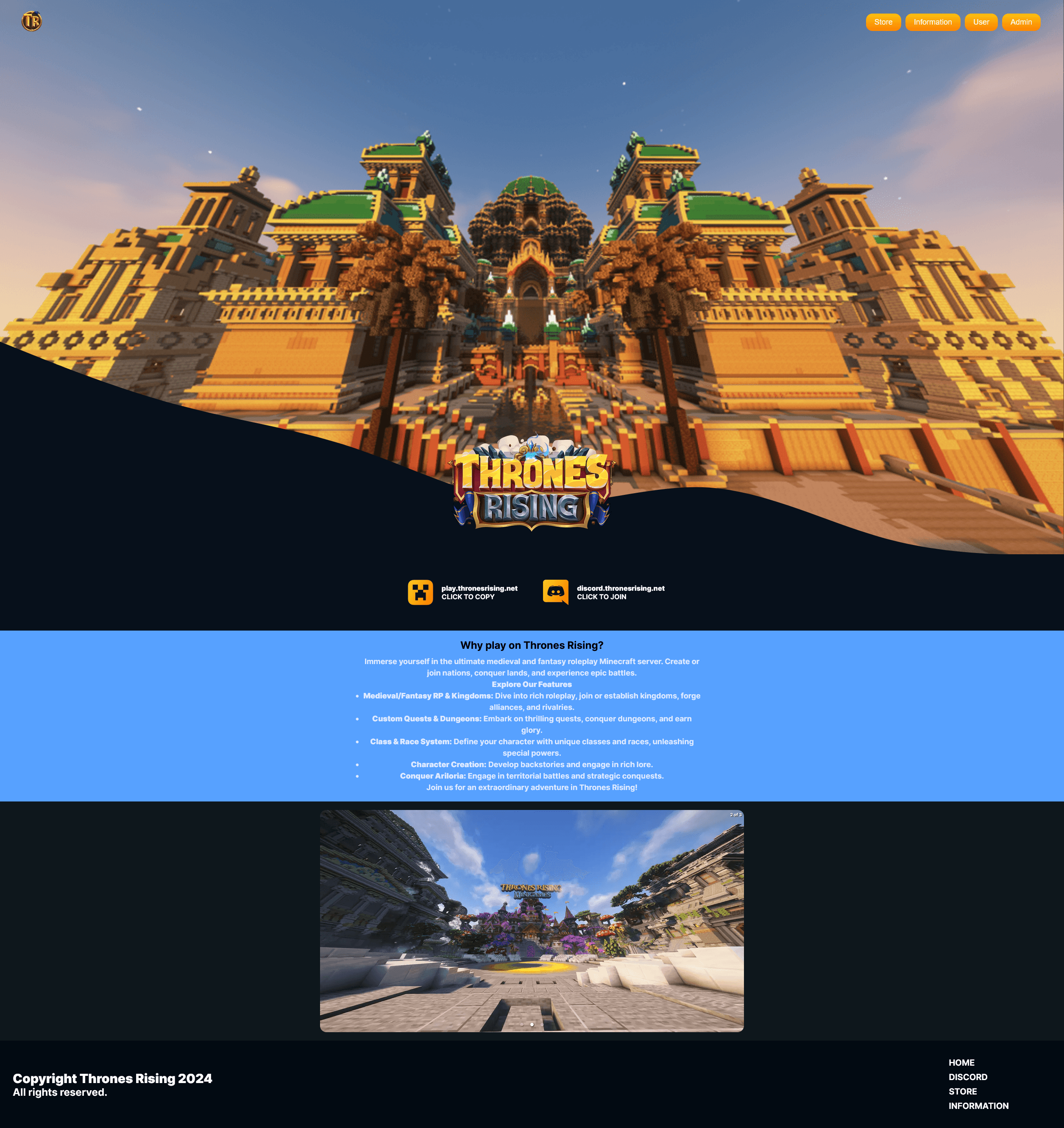
Thrones Rising was the first full website project I took over and finished. The site presents a Minecraft server brand with a visual landing page, server and Discord CTAs, store categories, rank/crate/coin pack products, cart checkout, PayPal payment surface, footer/legal areas, and admin product management.
First full website project: branded Minecraft server landing, store catalog, cart checkout, PayPal surface, and admin product management.
- Branded landing page with server and Discord calls to action
- Storefront catalog for ranks, crate keys, and coin packs
- Cart drawer with quantities, remove actions, totals, and PayPal checkout
- Admin product management for products, categories, admins, orders, and editable pages
Next.js · React · PayPal · Admin UI · Storefront UX
Case study features and evidence
The site combines a visual landing experience with practical commerce/admin flows for a game server: server and Discord CTAs, product categories, rank/crate/coin pack presentation, cart totals, and admin product controls.
Next.js · React · PayPal · Admin UI · Storefront UX · Responsive layout
Server landing page
Branded hero, navigation, play/Discord calls to action, feature copy, carousel-style media, and footer navigation for the server audience.
Storefront catalog
Rank, crate key, and coin pack categories with product cards, server artwork, prices, add-to-cart actions, and clear purchase intent.
Cart and PayPal checkout
Side-cart checkout flow with quantities, remove actions, totals, PayPal button, and debit/credit card payment option.
Admin product management
Admin area for managing products, categories, admins, orders, and editable pages from the same visual system as the public store.
Game-server trust details
Server links, Discord links, refund/terms areas, Mojang disclaimer, copyright footer, and product information affordances.
Game asset presentation
Uses custom rank artwork, server screenshots, logo treatment, background imagery, and consistent visual styling around the Thrones Rising brand.
Evidence
- Shows the start of the full-stack path: taking over a delayed project and finishing both frontend and backend work.
- Includes real buyer-facing store flows and internal admin surfaces, not just a static landing page.
- Useful proof of adapting to an existing visual design and turning it into working site sections.
Web Platforms
ProTeamHub
Comprehensive freelancing marketplace with secure payments and team management.
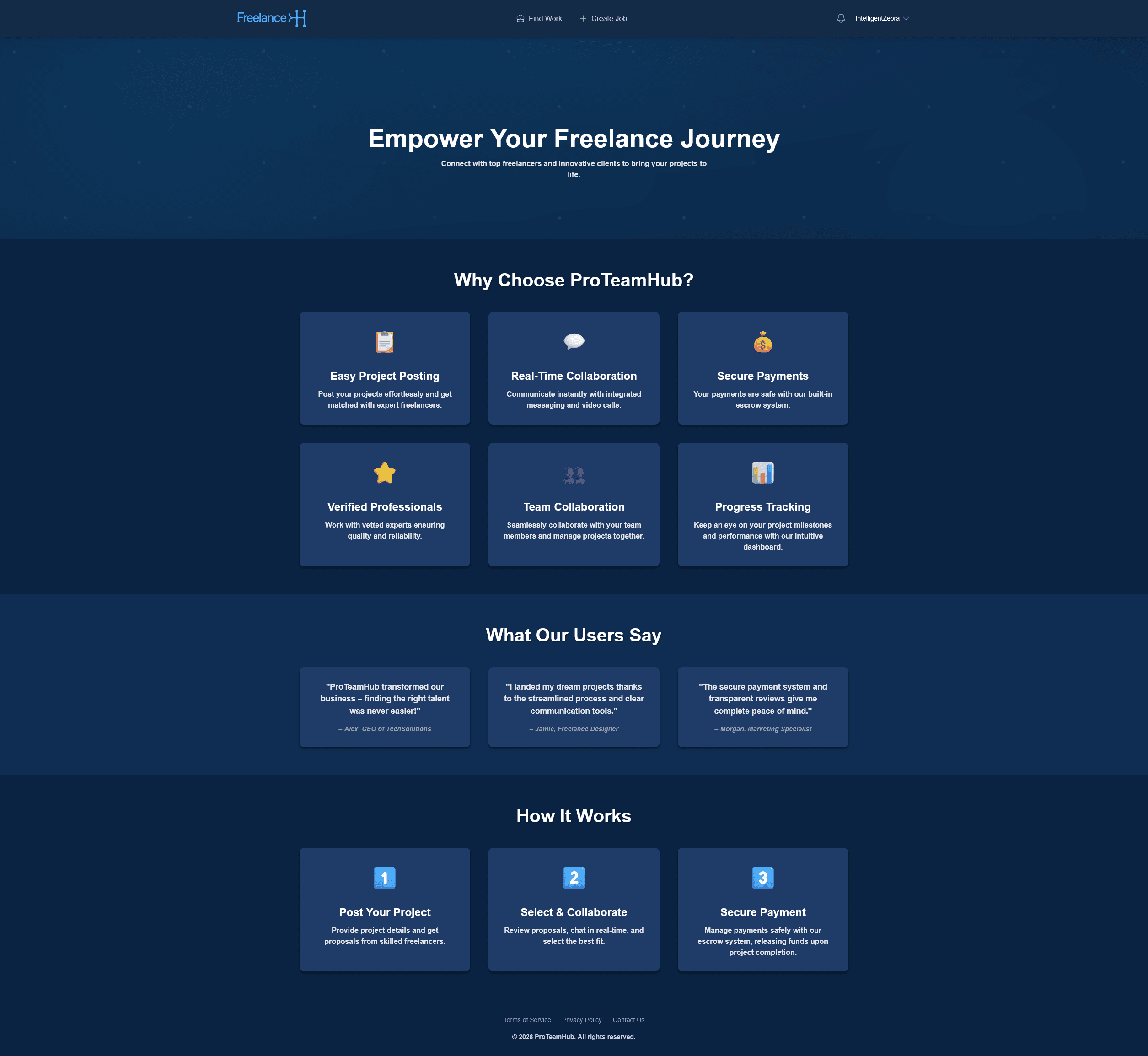
A platform architecture for freelancers and teams, with account flows, project management, file handling, and marketplace-style workflows.
Marketplace architecture, team workflows, RBAC, escrow concepts, and SaaS dashboards.
- Team dashboards
- Role-based workflow
- Project and file concepts
- Marketplace UX
Next.js · MongoDB · AWS S3 · NextAuth
Case study features and evidence
The platform covers roles, user flows, data models, team collaboration, project lifecycle, payment concepts, search, and marketplace UI.
Next.js · React · TypeScript · MongoDB · Mongoose · NextAuth · Stripe · AWS S3
Authentication and profiles
Account creation, profile completion, customer/freelancer roles, verification fields, and security utilities.
Projects and proposals
Project creation, listings, details, edits, status APIs, proposals, accept/deny/counteroffer flows.
Teams and network
Team models, invitations, avatars, friends/network features, reviews, and freelancer collaboration surfaces.
Messaging and notifications
Chat components, notification center, project workspace communication, and state-driven user feedback.
Payment concepts
Stripe routes, escrow, withdrawals, transaction history, milestones, and marketplace payment modelling.
Files and uploads
File upload dependencies and workspace concepts for project artifacts and collaboration.
Evidence
- Complex multi-role product architecture.
- Includes both UI and backend model/API thinking.
- Covers marketplace flows from profiles and teams to projects and proposals.
Gameplay & quests
Minecraft gameplay engineering, custom TypeWriter extensions and Dacia quest progression.
Minecraft Systems
TypeWriter Systems
Custom TypeWriter extensions and Minecraft server systems for RPG/adventure gameplay.
A suite of custom TypeWriter and Minecraft systems covering embedded MCP authoring, radial context menus, model-driven gameplay, voiceover/dialogue tooling, video cinematics, resource-pack readiness, checkpoints, spawnables, and quest utilities.
Custom Minecraft/TypeWriter systems: extensions, MCP authoring, model-driven gameplay, and RPG tooling.
- Interactive Context Menu Extension with browser visual editor
- Embedded JVM MCP Server for AI-assisted TypeWriter authoring
- ModelEngine/BetterModel combat, mounted, animation, and hitbox integrations
- Voiceover, BetterHUD, LuxDialogues, video, gaze, checkpoint, and spawnable systems
Kotlin · Paper · TypeWriter · MCP · BetterModel · ElevenLabs
Archived case study ↗AI Authoring
Embedded MCP Authoring Server
An embedded Model Context Protocol server that lets external tools and AI agents manage TypeWriter content safely.
Speed up quest/dialogue authoring by letting AI and external tools inspect, create, repair, translate, and manage TypeWriter content from controlled tools.
- Runs inside the Minecraft/TypeWriter runtime without requiring a separate Node sidecar.
- Exposes controlled JSON-RPC/MCP tools for blueprint inspection, entry creation, content repair, translations, voiceover generation, and server operations.
- Adds validation and repair flows to prevent malformed AI-generated JSON from breaking content.
Kotlin · MCP · JSON-RPC · ElevenLabs · TypeWriter
Technical details and use cases
Authoring accelerator for teams that need AI-assisted quest, dialogue, translation, and voiceover workflows inside a controlled Minecraft tooling stack.
Dependencies
- TypeWriter
- MCP clients
- ElevenLabs optional
- JSON-RPC
Setup notes
- Should be deployed behind explicit access controls.
- Needs clear operator documentation before being sold or reused externally.
Technical details
- Includes rate limiting, page-context validation, MP3/OGG utilities, and controlled server operations.
- Can generate localized voiceover assets and update sound/resource-pack metadata.
- Designed for authoring and repair, not player-facing gameplay.
Use cases
- AI-assisted quest and dialogue authoring.
- Repairing malformed entry JSON before it breaks live content.
- Generating localized voiceover assets and resource-pack sound updates.
Model Gameplay
ModelEngine / BetterModel Integrations
Model-driven entity systems for animations, hitboxes, combat actors, mounts, skins, equipment, and cinematics.
Turn animated models into gameplay actors instead of static decoration: combat entities, mounts, cutscene props, and interactive world objects.
- Controls custom model entities, attachments, bone equipment, player skins, debug controls, animation settings, body rotation, and model cinematics.
- Adds combat actor behavior with targeting, skills, windup/commit/recovery timing, threat handling, chase/retreat phases, and hurt reactions.
- Supports mounted player models with movement rules, stamina, particles, mounted animations, bone dynamics, terrain tilt, and diagnostic rotation.
Kotlin · ModelEngine · BetterModel · Paper · TypeWriter
Technical details and use cases
Integration package for servers that already use BetterModel/ModelEngine and need custom behavior, animation control, mounts, hitboxes, or combat logic around models.
Dependencies
- BetterModel or ModelEngine
- TypeWriter
- Paper
- Resource pack/model assets
Setup notes
- BetterModel itself is not authored here; the value is the custom integration, behavior, and workflow around it.
- Media should show the model, animation state, hitbox/combat behavior, and the gameplay result.
Technical details
- Good for animated RPG NPCs, bosses, rideable models, and props with gameplay hitboxes.
- Separates technical integration from pure model art.
- Can be sold as bespoke server implementation work.
Use cases
- Animated RPG NPCs and boss encounters.
- Mounted gameplay systems such as horses, wagons, or custom rideable models.
- Cutscenes and interactive model props with gameplay hitboxes.
World State
Spawnables Registry
Persistent and transient spawnable instances with gaze, interaction, facts, registry storage, and per-player scoping.
Let quests and systems create durable or player-scoped world objects with state, interactions, and cleanup behavior.
- Adds actions to add/remove instances, iterate records, and execute scoped simple actions.
- Stores spawn records and active contexts for player-specific world props or interactive objects.
- Supports permanent and variable-backed facts, gaze-record audiences, criteria audiences, pinned/transient groups, and dynamic individual instances.
Kotlin · TypeWriter · Gson · Persistent Artifacts
Technical details and use cases
Useful as a developer extension for serious RPG servers that need persistent props, collectibles, or per-player quest objects.
Dependencies
- TypeWriter
- Paper
- Gson/artifact storage
Setup notes
- Needs clear naming conventions for records and cleanup policies before use on production worlds.
Technical details
- Supports quest logic that needs durable object state.
- Can create player-specific collectibles and props.
- Works well with gaze-targeted interactions.
Use cases
- Per-player collectibles, props, interactive objects, and story state.
- Gaze-targeted interactions against spawned records.
- Quest logic that needs durable object state.
Dialogue / HUD
Voiceover, BetterHUD, LuxDialogues
Dialogue and HUD systems that synchronize text, sounds, options, popups, and inventory-change feedback.
Make RPG dialogue and reward feedback feel complete through synced voice, HUD popups, option dialogue, sounds, and resource-pack driven presentation.
- Voiceover entries add spoken, action-bar, and option dialogues with timed sounds.
- BetterHUD integration adds item popups, inventory hash watching, inventory gain/loss events, and custom popup variables.
- LuxDialogues integration adds NPC metadata, spoken/option/action-bar Lux dialogue, cinematic dialogue segments, popup sounds, typing sounds, and selected option context.
Kotlin · BetterHUD · LuxDialogues · TypeWriter · Resource Packs
Technical details and use cases
Setup and integration package for story servers that need voiced dialogue, polished reward feedback, and coherent HUD behavior.
Dependencies
- TypeWriter
- BetterHUD
- LuxDialogues
- Resource packs
Setup notes
- Requires consistent sound naming and resource-pack build workflow for voiceover-heavy projects.
Technical details
- Supports voiced RPG conversations with branching option selection.
- Can show reward/item popups when inventories change.
- Works well with cinematic dialogue sequences.
Use cases
- Voiced RPG conversations with branching option selection.
- Reward/item popups when inventories change.
- Cinematic dialogue sequences with synchronized sound timing.
Media Systems
Video & Cinematics
In-game video/cinematic playback using map screens, texture overlays, color mixers, FFmpeg, and YouTube/source resolution.
Bring tutorials, cutscenes, lore, transitions, and atmospheric videos into Minecraft experiences.
- Supports map video cinematics with anti-tear buffering, dithering, preload queues, frame dropping, full-screen camera placement, and item-frame packet control.
- Includes texture-overlay video cinematics and color mixer cinematics for full-screen transitions and atmosphere.
- Provides cache commands and supporting FFmpeg, yt-dlp/NewPipe, map encoding, and NMS packet utilities.
Kotlin · FFmpeg · Map Packets · yt-dlp · TypeWriter
Technical details and use cases
Cinematic/media extension or custom implementation for servers that want in-world video, tutorials, lore displays, or story presentation.
Dependencies
- FFmpeg
- yt-dlp/NewPipe optional
- TypeWriter
- NMS packets
Setup notes
- Needs media cache sizing, performance testing, and clear video length/resolution recommendations.
Technical details
- Useful for tutorial videos, cutscenes, lore displays, and full-screen transitions.
- Designed as a reusable media pipeline for resource-pack-driven experiences.
- Requires strong demo videos to sell well.
Use cases
- Tutorial videos, cutscenes, lore displays, or server advertisements inside Minecraft.
- Full-screen cinematic transitions during quests.
- Reusable media pipeline for resource-pack-driven experiences.
Client State
Resource Pack Readiness
Audience, fact, and event entries that detect whether a player has loaded the required resource pack.
Prevent custom models, sounds, videos, and HUD systems from triggering before the client is ready.
- Tracks pack status per player and exposes resource-pack-loaded audience filters, facts, and events.
- Includes status context keys so flows can branch based on readiness.
Kotlin · Paper · TypeWriter · Resource Packs
Technical details and use cases
Small but valuable support extension for servers with resource-pack-heavy gameplay.
Dependencies
- Paper
- TypeWriter
- Resource packs
Setup notes
- Pair with fallback messaging for players who reject or fail resource-pack loading.
Technical details
- Can delay custom models, sounds, videos, or HUD flows until the client is ready.
- Can show fallback instructions when a player has not loaded the pack.
Use cases
- Delay custom models, sounds, videos, or HUD flows until the client is ready.
- Show fallback instructions when a player has not loaded the pack.
- Protect immersive systems from being triggered on unprepared clients.
Interaction Logic
Gaze & Attention Filters
Audience filtering based on whether players are looking at TypeWriter entities.
Show prompts and trigger logic only when the player is actually paying attention to the relevant object or NPC.
- Checks per-player entity positions, distance, horizontal/vertical angles, optional line of sight, inversion, and sticky tick windows.
- Designed for prompts and interactions that should only appear when attention is focused.
Kotlin · Vector Math · TypeWriter
Technical details and use cases
Best as a utility extension bundled into RPG interaction packages.
Dependencies
- TypeWriter
- Paper vector math
Setup notes
- Tune angle/distance values per interaction so prompts do not feel noisy.
Technical details
- Supports inspection prompts and attention-gated object interactions.
- Reduces UI clutter by showing hints only at the right time.
Use cases
- Inspection prompts when looking at an object.
- NPC/object interactions that require attention.
- Reducing UI clutter by showing hints only at the right time.
Quest Tooling
Checkpoint & Utility Systems
Save/restore player fact snapshots and provide reusable utilities for objectives, variables, boss bars, repeated actions, and global monitors.
Make complex quest development easier to test, recover, and maintain.
- Checkpoint stores fact, position, and inventory snapshots in artifacts and can restore them for players.
- Utility entries support multi-track/untrack quest actions, repeated actions, calculated boss bars, multi-objective lines, context-scope variables, variable-value facts, and global condition monitors.
Kotlin · TypeWriter · Artifacts · Quest Logic
Technical details and use cases
Developer-facing extension set for teams building larger TypeWriter quest packs.
Dependencies
- TypeWriter
- Artifact storage
Setup notes
- Document which facts/inventory states are captured for each checkpoint type.
Technical details
- Supports repeatable quest testing and rollback points.
- Reduces duplicated TypeWriter wiring in complex RPG flows.
Use cases
- Repeatable quest testing and rollback points.
- Timed objectives, global triggers, and clean quest HUD display.
- Reducing duplicated TypeWriter wiring in complex RPG flows.
Infrastructure
Server Setup & Operations
Linux, Pterodactyl, Docker, Nginx, reverse proxy, backups, logs, domains/SSL, and production stability work.
Keep Minecraft/web systems deployable, debuggable, and recoverable in production.
- Commission work included bare-metal Linux setup, Pterodactyl, Docker, Wings, Nginx, multiple nodes, Velocity/minigame routing, and main-server operations.
- Games of Education hosting uses Linux, systemd, Nginx, HTTPS, and reverse proxying to a production Node/Express/Next process.
Linux · Docker · Pterodactyl · Nginx · systemd
Technical details and use cases
Setup and operations work for teams that need the server online, backed up, routed, secured, and maintainable.
Dependencies
- Linux
- Docker
- Pterodactyl
- Nginx
- systemd
Setup notes
- Strong proof includes uptime, topology diagrams, backup policy, and deployment notes.
Technical details
- Covers logs, services, backups, firewall/security basics, and reverse proxying.
- Connects game servers, websites, dashboards, and automation services.
Use cases
- Stable production Minecraft infrastructure.
- Recoverable deployments with logs, services, backups, and security basics.
- Connecting game servers, websites, dashboards, and automation services.
Act I campaign structure
The Village
A village campaign built as a sequence of NPC-led professions and escalating survival tasks. The player starts by helping the baker, moves into mining and blacksmith work, learns riding and archery, then follows the hunter into a bear-tracking finale.
- Meet Fane the Baker and follow a child through the fields to gather millet and spinach.
- Cook Dacian stew by filling the pot with water, adding ingredients, waiting for the cook timer, portioning bowls, and delivering food.
- Carry the story forward by delivering the stew to Fane the Blacksmith, moving naturally from village life into craft progression.
Custom systems
- Quest-state facts that reveal objectives only when the player reaches the correct story stage.
- Inventory-count objectives for gathered crops, stew bowls, tools, ore, ingots, honeycomb, arrows, and quest rewards.
- NPC interaction gates that move the story between named villagers without exposing TypeWriter logic to the player.
Objectives and evidence
Player objectives
- Gather 3 millet and 3 spinach.
- Keep pace with the guide NPC.
- Use the cooking pot sequence: water, ingredients, timer, bowls.
- Return to the baker and deliver stew to the blacksmith.
Evidence
- Built from 11 quest pages and 88 objective entries in the Act I export.
- Uses interact entity, location, completable, region, timer, inventory, and permanent-fact objectives.
Production-craft quest chain
Mining, Smelting, and Knife Forging
A hands-on craft sequence where the player mines ore, handles a furnace process, moves a bloom, forges an ingot, and turns it into a knife for the next story beat.
- Travel to the miner, pick up the pickaxe, and break metal nodes into ore.
- Operate the furnace: find the pail, move charcoal and ore, wait for the melt, break the shell, grab tongs, and move the bloom.
- Finish the blacksmith sequence by placing the ingot in the forge, picking up tongs and a hammer, striking the metal through staged progress, quenching the blade, and handing over the finished knife.
Custom systems
- Multi-stage forge state managed by permanent facts and inventory checks.
- Tool-dependent objectives that react to pickaxe, bucket, tongs, hammer, bloom, ingot, and knife states.
- Progressive objective text that reflects how many logs, hits, ingredients, or materials have already been added.
Objectives and evidence
Player objectives
- Crumble 4 metal nodes into ore.
- Fill the pail with charcoal and ore, then pour both into the furnace.
- Break the furnace shell, move the bloom, forge the ingot, and collect it.
- Heat, hammer, and quench the knife before returning it to the blacksmith.
Evidence
- The forging chain alone contains staged objectives for fuel, heat, tool pickup, anvil placement, hit counts, quenching, and NPC handoff.
- The design reads as gameplay, but the implementation is driven by custom state machines inside TypeWriter facts.
Training and world-interaction branch
Riding, Archery, and the Honey Job
The campaign widens from village production into outdoor traversal and precision tasks: the player earns a horse, clears hurdles, trains with a bow, and solves a honey-gathering task around living hives.
- Speak with the stablemaster, mount the horse, ride to the arena, and clear three checkpoint hurdles.
- Pick up the bow and arrows, move into the archery yard, shoot a first set of targets, climb the tower, then complete longer-range shots.
- Visit the flower glade, gather honeycomb with a stick, return to the blacksmith, then revisit the hives to put honey back into the correct nests.
Custom systems
- Mounted objective flow using horse-mounted state, location checks, timed checkpoint facts, and arena progression.
- Archery target progression using region checks and timed hit facts across ground and tower stages.
- Bee nest state using block data, display definitions, replenish timers, nest capacity facts, and per-nest honey counters.
Objectives and evidence
Player objectives
- Take the horse and complete three riding checkpoints.
- Shoot four ground targets, climb the tower, then shoot the final target set.
- Collect honeycomb from hives, track nest counts, and return honey to specific nests.
Evidence
- The honey quest page includes block data, shared entity instances, criteria audiences, timers, and nest-state facts.
- The training chain proves the quest system can combine movement, mounted gameplay, region logic, and precision target triggers.
Tracking, combat, and story payoff
The Bear Hunt Finale
The Act I finale turns earlier preparation into a guided hunt. The player follows Fane the Hunter, searches for clues, spawns and fights the bear, retrieves the heart, and carries the story into a portal transition.
- Follow the hunter into the forest and discover three clues in order.
- Use the clues to locate the bear, trigger the encounter, fight it, and finish the wounded state.
- Pick up the heart, deliver it to the healer, and move through the portal once the transition is ready.
Custom systems
- Sequential clue facts that control the search route and reveal the next objective only after each clue is found.
- Combat state for bear spawned, dying, killed, heart active, healer handoff, portal readiness, and final transition.
- NPC-led pacing that connects dialogue, exploration, combat, inventory rewards, and cinematic progression.
Objectives and evidence
Player objectives
- Follow Fane the Hunter.
- Find the first, second, and third clue.
- Find and fight the bear.
- Pick up the heart, give it to the healer, and go through the portal.
Evidence
- The finale uses permanent facts to manage clue order, spawned combat state, reward pickup, healer delivery, and portal activation.
- This is a narrative quest sequence implemented as custom gameplay state, not a static checklist.
Mob-Moves also has spatial scene authoring, entities, quest flows and cinematics. The complete quest-to-server publication workflow is still under development.
Archived Minecraft systems and case studies ↗Servers & DevOps
Infrastructure for web applications, Minecraft servers and production tools.
Minecraft Setup
RPG/adventure servers, NPC/dialogue systems, economy/shop systems, custom item/resource-pack setups, progression systems, minigame mechanics, and general plugin integration.
Production Operations
Linux setup, deployment, backups, firewall/security basics, logs, crash debugging, performance debugging, databases, reverse proxies, domains/SSL, Docker, and Pterodactyl.
Web + Automation
Next.js/React/TypeScript systems, Discord webhooks/bots, agentic automation, dashboards, nonprofit and marketplace workflows, and backend logic.
Linux · Docker · Pterodactyl · Nginx · PostgreSQL · deployment · logs · recovery
Automation & tools
AI orchestration, browser automation, media pipelines and desktop tools.
AI / MCP
Codex Hivemind
Autonomous AI Orchestration Platform coordinating a swarm of sandboxed agents.
A distributed control plane for AI coding agents. It manages task decomposition, sandboxed execution, memory retrieval, and Model Context Protocol communication across multiple specialized workers.
Agent orchestration, memory routing, MCP tooling, and automated execution systems.
- Multi-agent task routing
- MCP-compatible tool layer
- Dockerized execution sandboxes
- Memory retrieval and context routing
Rust · Docker · MCP · Redis · Next.js 14
Case study features and evidence
Built as a control surface for task decomposition, agent execution, memory/context routing, infrastructure isolation, and operational visibility.
Rust · Docker · MCP · Redis · Next.js 14 · Agent tooling · Sandboxing
Agent orchestration
Coordinates specialized workers instead of treating one assistant as the whole system.
Task decomposition
Breaks larger coding objectives into smaller agent-owned execution paths.
Sandboxed execution
Uses Docker-oriented isolation patterns so agent work can run with clearer operational boundaries.
Memory routing
Routes context and retrieved memory to the worker that needs it instead of flooding every task with the same data.
MCP tool layer
Builds around Model Context Protocol style tooling so agents can call structured capabilities instead of relying only on chat text.
Control-plane thinking
Frames AI as an operated system with workers, queues, state, execution, and visibility rather than a prompt-only feature.
Evidence
- AI infrastructure and web control surfaces around real developer workflows.
- Combines backend systems, orchestration, containers, tool protocols, and product UI.
- Designed for operated agent workflows instead of one-off prompt experiments.
Automation
Dropship Automation
End-to-end dropshipping automation suite with visual scraping and inventory sync.
Automation for product monitoring, pricing checks, inventory workflows, browser scraping, and operational dashboards.
Browser automation, inventory protection, pricing logic, and operational dashboards.
- Playwright scraping workflows
- Inventory sync logic
- Pricing guardrails
- Operational dashboard
Playwright · Amazon SP-API · Next.js 16 · Python
Media
Content Studio
Programmatic video editing engine for automated content generation.
A media automation system for assembling video from structured inputs, managing render jobs, and preparing repeatable content pipelines.
Programmatic video rendering, FFmpeg pipelines, and scalable media workers.
- FFmpeg render pipeline
- Template-based composition
- Queue-friendly architecture
- Preview-oriented UI
Node.js · FFmpeg · React 18 · Streams
Tools
Valgrim Design
Programmatic design pipeline for automated game asset generation.
Tooling for generating and validating design assets through scripts and repeatable export workflows.
Asset automation, SVG/raster pipelines, batch tooling, and QA scripts.
- Batch asset generation
- SVG and raster handling
- Automation scripts
- Repeatable QA flow
Python · SVG · Batch Scripting · Design
AI / MCP
Jerry v5.0
Offline-capable desktop AI assistant with voice interaction.
A desktop assistant experiment focused on local AI interaction, voice, and responsive utility UI.
Offline AI assistant patterns, local inference, TTS, and desktop responsiveness.
- Local assistant UI
- Voice interaction
- Tkinter app shell
- Offline-capable workflows
Python · PyTorch · Blenderbot · Tkinter
Tools
Flux Timer
Interactive countdown timer with physics-based dial controls.
A compact desktop tool with custom canvas rendering, interaction polish, and timer workflows.
Custom desktop tooling, canvas rendering, and physics-based interactions.
- Canvas-rendered timer
- Physics dial interaction
- Desktop utility workflow
- Focused UI
Python · Tkinter Canvas · Physics


